

There’s a gambling strategy that’s been around for hundreds of years that supposedly lets you recover every dollar you’ve lost simply by doubling your next bet.
Lose $10? Bet $20.
Lose that? Bet $40.
Lose again? Bet $80.
Eventually, you’re going to win, recover all your losses, and walk away with a $10 profit.
Sounds pretty fucking brilliant, doesn’t it?
That’s the Martingale betting strategy, and I’ve heard plenty of gamblers swear by it.
The part that always confuses me is when somebody explains how successful this strategy is while sitting at a blackjack table with about $300 to their name.
I’m not sure they’ve thought this whole thing through.
Don’t get me wrong. I’ve chased losses before. I’ve increased my blackjack bets after losing several hands in a row, and I’ve had it work so many times that I’ve felt practically invincible.
I’ve also turned a perfectly good $1,000 gambling session into a story that ends with me screaming into a pillow.
We’ll get to that.
But first, let’s look at how Martingale actually works, why people love it, and why the casino isn’t particularly worried about somebody discovering this centuries-old betting system.
Table of Contents
- What Is the Martingale Betting Strategy?
- How Does the Martingale Strategy Work?
- Why People Think Martingale Is Unbeatable
- My $700 Blackjack Bet That Went Horribly Wrong
- Can You Lose Seven Blackjack Hands in a Row?
- The Problem With Casino Table Limits
- Can You Use Martingale With a Small Bankroll?
- Martingale on Roulette vs. Blackjack
- Does Martingale Actually Beat the Casino?
- Martingale Pros and Cons
- Would I Recommend Martingale?
- Final Thoughts
- Frequently Asked Questions
What Is the Martingale Betting Strategy?
The Martingale strategy is a progressive betting system traditionally traced back to 18th-century France.
The concept is incredibly simple.
You double your bet after every loss and return to your original wager after every win.
The goal is to recover everything you’ve lost during that betting sequence and finish with a profit equal to your original bet.
For example, suppose you’re playing roulette and betting $10 on black.
You lose the first spin, so you bet $20.
Lose again? Bet $40.
Keep losing? Keep doubling.
When black finally hits, the winning wager should cover your previous losses and leave you $10 ahead.
That is, assuming you’re making even-money bets, have enough money to continue, and the casino allows you to place the next wager.
Those last two details are pretty important.
Martingale is most commonly associated with roulette, although people also discuss using it in blackjack, baccarat, and craps.
And while the mechanics are easy enough to understand, the mathematics can get ugly in a hurry.
How Does the Martingale Betting Strategy Work?
Let’s use a $10 starting wager and see how quickly things escalate.
You’re playing roulette, betting on red, and experiencing the kind of losing streak that makes you start questioning your life decisions.

| Bet Number | Your Bet | Total Lost If You Lose |
|---|---|---|
| 1 | $10 | $10 |
| 2 | $20 | $30 |
| 3 | $40 | $70 |
| 4 | $80 | $150 |
| 5 | $160 | $310 |
| 6 | $320 | $630 |
| 7 | $640 | $1,270 |
| 8 | $1,280 | $2,550 |
| 9 | $2,560 | $5,110 |
| 10 | $5,120 | $10,230 |
Look at that table.
You started with a completely reasonable $10 wager.
After losing seven consecutive bets, you’re down $1,270 and need to put $1,280 on the table just to continue.
If that eighth bet wins, you’ve recovered your losses and made $10.
Ten dollars.
You just put $1,280 at risk to make enough money for a couple of cheap beers.
Now imagine losing that bet, too.
Suddenly, you’re down $2,550, and your next wager needs to be $2,560.
This is the part that people tend to gloss over when they’re telling you how great Martingale is.
The system doesn’t fail because the doubling formula is incorrect.
It fails because your bankroll isn’t infinite, and neither are the casino’s betting limits.
Why People Think Martingale Is an Unbeatable Betting System
Here’s the thing about Martingale.
It can work.
In fact, it can work repeatedly.
You might win your first bet.
Then lose two, win the third, and recover everything.
Maybe you lose four straight before hitting your next winner.
Every completed winning sequence leaves you with the same small profit.
After a while, you start thinking you’ve figured something out.
I’ve experienced a similar feeling playing blackjack.
I don’t actually use Martingale. My bankroll isn’t nearly big enough to start doubling every hand, and I generally have a different approach to betting.
But have I lost five consecutive blackjack hands and decided that the next hand deserves a substantially larger wager?
Absolutely.
Sometimes I’ll double my bet.
Sometimes I’ll throw $100 or $200 out there.
Once, I even went as high as $700.
And plenty of times, pressing my bet after a losing streak has worked beautifully.
I’d win the hand, recover a nice chunk of money, and go right back to my regular bet feeling like I had just outsmarted the entire casino.
It’s an incredible feeling.
The problem is that those successful experiences make the unsuccessful ones seem almost impossible.
Until they happen.
It’s something I’ve talked about before in my article about the lies gamblers tell themselves. We can convince ourselves of just about anything when there’s money sitting on a casino table.

My $700 Blackjack Bet That Went Horribly Wrong
I learned a pretty expensive lesson about chasing losses while playing blackjack on the BetMGM app.
It all started with some free play.
I managed to turn that promotional money into approximately $1,000, which was a pretty nice result considering I hadn’t deposited any money of my own.
Naturally, I continued playing.
I played throughout the day, even after getting home from work.
At some point, I was sitting there playing $5 blackjack hands and started losing.
One hand.
Another hand.
Then another.
And eventually I got frustrated.
I decided I needed to make a bigger bet to recover what I’d been losing.
A much bigger bet.
Seven hundred dollars.
Let me repeat that.
I went from playing $5 blackjack hands to placing a $700 bet because apparently I had decided the next hand was going to solve all my problems.
It didn’t.
I lost.
And that was it. The last $700 was gone.
I screamed into my pillow, accepted my defeat, and went on with my day.
But here’s the best part.
I actually tried convincing myself that I hadn’t lost anything.
My reasoning was that I started with free play, hadn’t deposited my own money, and therefore hadn’t really lost anything.
Which is complete bullshit.
That $1,000 was real money once I’d won it.
I could have cashed it out.
Instead, I gave it all back.
That’s some pretty impressive mental gymnastics when you think about it.
And while what I was doing wasn’t technically Martingale, it came from a similar mindset.
I’d lost several hands, I wanted my money back, and I convinced myself a much larger wager was the answer.
Sometimes that works.
Sometimes you end up screaming into your pillow.
Different outcomes to the same terrible decision, I guess.
Can You Really Lose Seven Blackjack Hands in a Row?
I’ve caught myself thinking that there’s no way I could possibly lose seven blackjack hands in a row.
Mathematically, it just feels ridiculous.
Except it’s absolutely possible.
Blackjack isn’t a coin flip. The odds depend on the specific game rules, your decisions, and whether pushes are counted.
But losing seven consecutive resolved hands is entirely possible, even if you’re playing perfect basic strategy.
And here’s where gamblers get themselves into trouble.
We start believing that because something is unlikely, it can’t happen.
Or that because we’ve already lost several times, a win must be coming.
That’s known as the gambler’s fallacy.
An independent roulette spin doesn’t become more favorable because the last seven spins went against you.
On a standard American double-zero roulette wheel, black wins on 18 of the 38 pockets.
That’s about 47.37%.
If red has hit seven times, black still has the same 47.37% chance on the next spin.
The roulette wheel doesn’t know you’re down $1,270.
And I’m fairly certain it wouldn’t care if it did.
The Biggest Problem With Martingale: Casino Table Limits
There’s something I’ve always wondered when people tell me they’re going to use Martingale to beat the casino.
What happens when you reach the table maximum?
Seriously.
Even if you had an unlimited bankroll, casinos aren’t going to let you increase your bets forever.
Every table has betting limits.
Some might let you wager a few hundred dollars per spin. Others allow thousands. High-limit tables can accommodate substantially larger bets.
But eventually, there’s a ceiling.
Let’s say you’re playing at a roulette table with a $1,000 maximum wager.
You start with $10.
After six losses, your next bet is $640.
Lose that, and the system requires a $1,280 wager.
Except the casino won’t let you make that bet.
Now what?
You’ve lost $1,270, and the maximum you’re allowed to wager is $1,000.
Even if your next $1,000 even-money bet wins, you’re still down $270.
Your Martingale progression is broken.
And it doesn’t matter whether you’ve got another $500 or $5 million in your bankroll.
You’re still subject to the table maximum.
Casinos aren’t required to let you keep increasing your bets just because you’ve got a system.

What About Using Martingale With a Small Bankroll?
This is where I get confused watching people explain Martingale at casino tables.
I’ve heard gamblers swear by this strategy while knowing they only have a few hundred dollars available.
Let’s say you’ve got $300 and want to use Martingale at a $10 table.
Your betting progression looks like this:
$10 → $20 → $40 → $80 → $160.
If you lose the first four wagers, you’ve already lost $150.
Now you need to wager $160.
You can’t afford it.
The system requires you to bet more money than you have left.
And that’s with a $10 starting bet.
At a $15 table, the numbers get even worse.
You can play $15, $30, $60, and $120.
Lose those four bets, and you’re down $225.
Your next wager is supposed to be $240.
You’ve got $75 left.
Good luck with that.
Now, if somebody sits next to me at a $15 blackjack table and tells me they’ve got $300 and they’re about to make a fortune using Martingale, I’m probably not going to give them a lecture about probability.
I’m going to tell them, “Hell yeah, you got this.”
And then I’m going to watch.
I enjoy watching people try different betting systems.
Maybe they’ll have a great session.
Maybe they’ll lose everything.
Either way, I’m curious to see how it plays out.
It’s also why I think understanding your bankroll matters a lot more than memorizing some magical betting progression. I’ve written about ways to make your Vegas gambling money go further, and none of them involve pretending a losing streak can’t happen.
Is Martingale Better for Roulette or Blackjack?
If somebody forced me to use the Martingale betting strategy, I’d probably choose roulette.
Personally, I’d much rather play blackjack normally or spend some time on high-limit slots.
But roulette makes more sense for a traditional Martingale system because you have straightforward even-money bets.
Red or black.
Odd or even.
High or low.
You can also spread wagers across different sections of the roulette layout, which gives you more flexibility in how you play.
However, spreading bets doesn’t automatically make Martingale more effective or get around the table limits. The original system relies on even-money payouts, and mixing other types of wagers changes the calculations.
Martingale on Roulette
Roulette is generally the simplest game for understanding Martingale.
But the type of roulette wheel matters.

| Roulette Type | Standard House Edge |
|---|---|
| European roulette (single zero) | 2.70% |
| American roulette (double zero) | 5.26% |
| Triple-zero roulette | 7.69% |
Those are the standard house edges for conventional roulette payouts. Certain special rules, such as la partage, can improve the odds on eligible even-money wagers.
If you want the complete breakdown of the different roulette wheels and their odds, the Wizard of Odds roulette guide explains the mathematics behind each version.
The important thing to understand is that Martingale doesn’t change those percentages.
Doubling your bet doesn’t make a double-zero roulette wheel any less terrible.
It just means you’re wagering more money against the same house edge.
Martingale on Blackjack
Blackjack is a different animal.
You’ve got decisions to make, multiple possible outcomes, pushes, doubles, splits, and different payouts for natural blackjacks.
A strict Martingale progression gets complicated when you have to account for all of those situations.
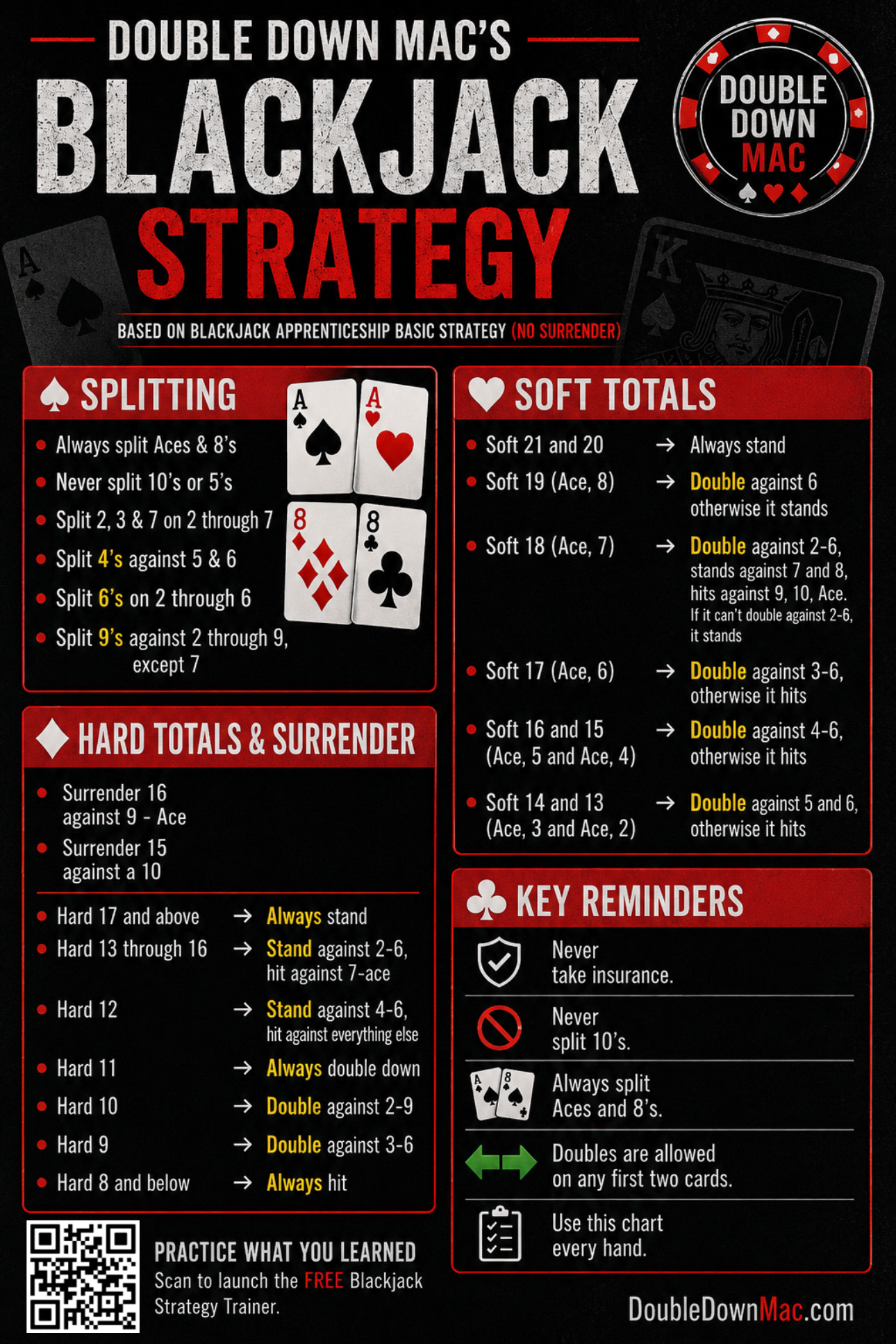
That’s why I stick to my own blackjack approach.
Normally, I play the table minimum.
When the pit boss is watching, I’ll increase my bet to two, three, or sometimes four times the minimum.
Why?
Because I’m hoping the pit boss rates my average wager higher, which could help me earn better casino comps.
I’m not claiming it always works. Casinos have their own systems for tracking play.
But that’s the thinking behind it.
When the pit boss isn’t paying attention, I generally go back to the minimum.
And if I lose five or more consecutive hands, that’s when things can change.
Sometimes I press my bet.
Sometimes considerably.
But when I win, I go back to my normal betting amount.
It’s not Martingale.
It’s more of a loosely organized system involving blackjack, frustration, and questionable financial decisions.
I wouldn’t recommend confusing it with a mathematical advantage.
If you’re new to blackjack, you’re much better off understanding the actual rules and decisions first. My how to play blackjack guide covers the basics without pretending there’s a magical way to guarantee every hand.
Does the Martingale Strategy Actually Beat the Casino?
No.
And this is the most important thing to understand about the entire strategy.
Martingale does not eliminate the house edge.
It doesn’t improve your odds of winning an individual bet.
It doesn’t make you more likely to win the next spin.
And it doesn’t guarantee that you’ll eventually recover your losses within your bankroll or table limits.
Michael Shackleford, the gambling mathematician behind Wizard of Odds, has examined this system extensively.
His Martingale betting system analysis explains why the strategy produces frequent small winning sessions while exposing gamblers to occasional devastating losses.
Essentially, you’re exchanging many small wins for the risk of one enormous loss.
And that’s why the strategy can be so convincing.
Most people remember all the times they walked away winning.
They remember turning $100 into $150.
They remember using Martingale for an hour and making a few bucks.
They don’t necessarily lead with the story about the night the system finally caught up with them.
Although, to be fair, I think most of these gamblers are genuinely enjoying themselves.
They’re not necessarily trying to scam anybody or sell some ridiculous secret formula.
They’ve found something that makes gambling entertaining for them.
And really, isn’t that part of why we’re all there?
The Pros and Cons of the Martingale Betting System
Martingale isn’t complicated, but there are definite advantages and disadvantages worth considering.
Pros of Martingale
- It’s easy to understand. You don’t need to memorize complicated formulas. Just double your wager after every loss.
- It can produce frequent small wins. Many sequences end with a win before your bankroll or table limit becomes a problem.
- It provides a clear betting structure. You know exactly what your next wager is supposed to be.
- It can make gambling entertaining. Some players enjoy the challenge and excitement of trying a progressive betting system.
Cons of Martingale
- Losing streaks get expensive fast. A $10 starting wager can turn into a required $1,280 bet surprisingly quickly.
- Your bankroll is limited. Eventually, you may be unable to afford the next wager.
- Casinos have table maximums. Even a wealthy player can be prevented from continuing the progression.
- It doesn’t change the house edge. You’re still playing the same game with the same mathematical disadvantage.
- One bad sequence can erase numerous wins. All those successful $10 profits can disappear in one ugly session.
That final disadvantage is the one I think people underestimate the most.
It’s easy to feel successful when you’re collecting small wins over and over.
It’s much harder to accept that one losing streak can erase all of them.
Would I Ever Recommend the Martingale Betting Strategy?
Here’s where I probably differ from some gambling strategy writers.
I’m not going to sit here and tell you that you should never try Martingale.
If you’ve got money set aside for gambling, understand the risks, and want to experiment with a betting system, that’s your decision.
I’m certainly not going to judge somebody else’s gambling choices while sitting here knowing I’ve chased several $5 blackjack losses with a $700 wager.
That would be a little hypocritical.
But I also wouldn’t tell anybody that Martingale is a reliable way to make money.
If you’re going to try it, at least understand how much money a losing streak could cost before you begin.
Set a hard loss limit, check the table maximum, and don’t start pulling out additional money because the next bet is supposedly guaranteed to win.
Personally, if I walked into a casino with $5,000 to gamble, I wouldn’t spend the night doubling $10 roulette bets.
I’d rather play blackjack normally.
Or maybe head over to the high-limit slot room and see what happens.
I’m not saying that’s a smarter financial decision.
It’s just what I’d rather do.
And honestly, half the fun of Vegas for Nikki and me is the whole experience, not just how much money we walk away with.
That’s why I always tell people to find your own Vegas. Some people love the high-limit rooms. Some love penny slots. Some apparently enjoy doing increasingly expensive multiplication problems at roulette tables.
Whatever works for you.
Final Thoughts: Martingale Works Until It Doesn’t
The Martingale betting strategy is one of those ideas that sounds almost too simple to fail.
Lose a bet.
Double it.
Eventually win.
Recover everything.
And mathematically, the recovery calculation is correct, provided you can keep making the required even-money wagers until one wins.
The problem is everything that happens between losing the first bet and finally getting that win.
Your bankroll gets smaller.
Your bets get larger.
The table maximum gets closer.
And eventually, there’s a very real possibility that you can’t afford to continue.
I’ve never seriously attempted a full Martingale progression because I know my bankroll isn’t built for that.
But I’ve certainly experienced the mindset behind chasing a loss.
I’ve pressed blackjack bets, won, and felt invincible.
I’ve also lost $700 on a single hand after starting the day with $1,000 in winnings.
And I somehow managed to convince myself that losing money I’d won didn’t count as losing money.
So clearly, I’ve got this gambling thing completely figured out.
If somebody wants to try Martingale, I’m happy to hear their strategy.
Who knows? Maybe they’ve got something interesting.
I’ll be over at the blackjack table playing the minimum, occasionally betting four times as much when the pit boss walks by, and trying not to convince myself that five losing hands mean the sixth one owes me something.
Hopefully, by the end of the trip, I’ve got a few winnings left to cash out. And if I do, there’s a pretty good chance the ticket ends up in our collection of Las Vegas casino cash-out ticket souvenirs.
Although judging by that BetMGM session, sometimes the only thing I’m taking home is a story.
Different approaches to the same problem, I guess.
Frequently Asked Questions About the Martingale Betting Strategy
What is the Martingale betting strategy?
The Martingale betting strategy is a progressive system where you double your wager after each loss and return to your original bet after a win. On an even-money bet, a completed winning progression recovers previous losses and produces a profit equal to your starting wager.
Does the Martingale strategy actually work?
Martingale can produce frequent winning sequences, but it doesn’t provide a mathematical advantage over the casino. Long losing streaks, limited bankrolls, and maximum table wagers can prevent you from recovering your losses.
How much money do you need to use Martingale?
It depends on your starting wager and how many consecutive losses you want your bankroll to cover. For example, starting at $10 requires $1,270 to cover seven consecutive losses. You’d then need another $1,280 to place the eighth wager.
Can you use Martingale in blackjack?
Yes, but blackjack introduces complications because of pushes, doubles, splits, and varying payouts. Martingale doesn’t replace blackjack basic strategy or improve the underlying odds of the game.
Is Martingale better for roulette?
Roulette is generally easier for applying a traditional Martingale strategy because it offers straightforward even-money bets such as red or black. However, the strategy still doesn’t eliminate the house edge. Single-zero European roulette generally offers better odds than standard double-zero American roulette.
Can you lose seven bets in a row using Martingale?
Absolutely. Seven consecutive losses are mathematically possible, and longer streaks can happen. Each independent roulette spin has the same probability of winning or losing regardless of previous results. A losing streak doesn’t guarantee that the next bet will win.
Why doesn’t Martingale work with casino table limits?
Martingale requires progressively larger wagers after each loss. If the next required wager exceeds the table maximum, you can’t continue the original progression, even if you have enough money available.
What happens if you run out of money using Martingale?
If you can’t afford the next required bet, you cannot continue the progression as designed. You may be left with substantial losses that previous small wins don’t cover.
Is Martingale a good strategy for beginners?
It’s easy for beginners to understand, but its rapidly escalating wagers make it financially risky. Beginners should understand the underlying game odds, establish a firm gambling budget, and avoid treating Martingale as a guaranteed way to win.
Can Martingale make you rich?
Martingale doesn’t create a positive expected return in a negative-expectation casino game. While someone can win money using it, the system offers no reliable path to long-term profits and can produce substantial losses.
Gambling should be entertainment, not a financial plan. Never wager money you cannot afford to lose.