
I’ve been playing blackjack since I was a kid. Not in casinos, obviously, but sitting around playing single- and double-deck games with friends for a dollar a hand.
Even back then, I liked trying to keep track of the Aces coming out of the deck. I didn’t know how to count cards, but I understood that knowing which cards had already been played might be useful.
I knew blackjack strategy existed, too. I just didn’t care enough to learn it.
Years later, I watched a documentary called Holy Rollers: The True Story of Card Counting Christians, which eventually led me to Colin Jones and Blackjack Apprenticeship.
That’s when I started taking the game a little more seriously.
What surprised me wasn’t how badly I’d been playing. It was how much there actually was to learn about a game I’d already been playing for years.
Something as simple as having an Ace and a 7 completely changes depending on what card the dealer is showing.
There’s a lot more to blackjack than trying to get to 21.
These days, I’ve memorized basic strategy, spent countless hours practicing, and played more blackjack hands than I could possibly remember.
I’ve also made plenty of terrible betting decisions.
Knowing how to play blackjack correctly and knowing when to stop gambling are apparently two different skills.
Anyway, if you’re new to blackjack, this guide will walk you through the rules, explain basic strategy, and show you what to expect when you sit down at a real casino table.
Table of Contents
- What Is Blackjack?
- Blackjack Card Values Explained
- How a Round of Blackjack Works
- The Five Main Blackjack Decisions
- What Is Blackjack Basic Strategy?
- Free Blackjack Strategy Chart & PDF
- Blackjack Rules That Change Strategy
- Should You Take Insurance?
- Your First Casino Blackjack Table
- Do Other Players Affect Your Results?
- How Much Money Should Beginners Bring?
- Understanding Winning and Losing Streaks
- Biggest Beginner Blackjack Mistakes
- Is Blackjack Skill or Luck?
- How to Get Better at Blackjack
- Frequently Asked Questions
- Final Thoughts
What Is Blackjack?
Blackjack is a casino card game where you’re playing against the dealer, not the other players at the table.
The goal is simple: beat the dealer without going over 21.
You don’t necessarily need 21 to win. You just need a better hand than the dealer, or for the dealer to go over 21.
Let’s say you’re holding a 19 and the dealer has 18. You win.
If you’re holding 16 and the dealer goes over 21, you also win.
But if you’re holding 22, you’ve already lost. It doesn’t matter if the dealer eventually goes over 21, too.
That’s called busting, and once you bust, your bet is gone.
One of the first things beginners need to understand is that blackjack isn’t about getting as close to 21 as possible on every hand.
It’s about making the mathematically correct decisions based on the cards you’re holding and the dealer’s visible card.

Blackjack Card Values Explained
Before you start making decisions, you need to understand what the cards are worth.
Fortunately, this is the easy part.
- Cards 2 through 10: Worth their face value.
- Jack, Queen, and King: Worth 10 points each.
- Ace: Worth either 1 or 11, depending on which value benefits your hand.
For example, if you’re dealt a 7 and a King, you have 17.
If you’re dealt an Ace and a 6, you have either 7 or 17.
That second example is important because it introduces something you’ll hear a lot when learning blackjack strategy: hard hands and soft hands.
What’s the Difference Between a Hard Hand and a Soft Hand?
A hard hand is a hand that doesn’t contain an Ace being counted as 11.
A 10 and a 6 give you a hard 16.
A 9 and an 8 give you a hard 17.
A soft hand contains an Ace that can currently count as 11 without causing you to bust.
An Ace and a 6 give you a soft 17.
An Ace and a 7 give you a soft 18.
The difference matters because you can take another card on a soft hand without immediately busting. If necessary, the Ace simply changes from 11 to 1.
That makes soft hands more flexible and changes how you should play them.
Honestly, soft totals were one of the things that made me realize just how much there was to blackjack strategy.
A soft 18 seems like a pretty good hand. Most beginners would probably stand without thinking twice.
But against a dealer showing a 9, hitting that soft 18 is the correct basic strategy play under the rules I use.
We’ll get into that shortly.
How a Round of Blackjack Works
Once you understand the card values, the actual flow of a blackjack game is pretty straightforward.
Step 1: Place Your Bet
Before the dealer starts dealing, you place your chips in the betting circle in front of you.
Every table has a minimum and maximum bet.
You might find a $15 table, a $25 table, or something considerably more expensive.
If you’re new, I recommend finding a table with a minimum you’re comfortable playing for a while.
Remember, you’re not necessarily going to play one hand and leave.
Step 2: The Dealer Gives Everyone Two Cards
At most standard shoe-dealt casino blackjack tables, players receive two cards face up.
The dealer also receives two cards, usually one face up and one face down.
The dealer’s visible card is called the upcard.
Pay attention to that card. It’s one of the most important pieces of information you’ll use when deciding how to play your hand.
Step 3: Each Player Makes a Decision
Starting with the first player, everyone decides what to do with their hand.
You can hit, stand, double down, split, or sometimes surrender.
Step 4: The Dealer Plays Their Hand
After all players have finished, the dealer reveals the hidden card and completes their hand according to the casino’s rules.
Unlike you, the dealer doesn’t get to make decisions.
The dealer must hit below 17 and follow the table’s rule for soft 17.
Step 5: Bets Are Settled
If you beat the dealer, you get paid.
If the dealer beats you, you lose your wager.
If you both have the same total, it’s called a push, and you get your original bet back.
Ordinary winning hands generally pay even money. A natural blackjack normally pays 3:2 at a traditional table, although some games pay less.
Then the next round begins.
The Five Main Blackjack Decisions
Here’s where the actual strategy starts.
Every decision you make at the blackjack table affects the mathematical expectation of your hand.
And while some decisions are obvious, others can get surprisingly complicated.
1. Hit
Hitting means asking the dealer for another card.
Let’s say you have a 7 and a 5, giving you a hard 12.
If the dealer is showing a 10, basic strategy tells you to hit.
You might bust, but hitting is still the better long-term decision.
That’s something beginners need to get comfortable with.
Making the correct decision doesn’t guarantee you’ll win the hand.
2. Stand
Standing means you’re keeping your current total and don’t want additional cards.
For example, if you have a hard 16 and the dealer is showing a 6, basic strategy tells you to stand.
You might think having 16 is terrible, and you’d be right.
But the dealer has a relatively weak upcard and is more likely to bust than when showing a high card.
Taking another card yourself isn’t necessarily the better option.
3. Double Down
Doubling down is one of my favorite moves in blackjack.
You double your original wager in exchange for receiving exactly one additional card.
If you started with a $25 bet, doubling makes your total wager $50.
Then you get one card, and your turn is over.
You don’t get to hit again.
For example, if you’re holding an 11 and the dealer is showing a 6, you’re in an excellent position to double down.
But not every double is obvious.
Depending on the dealer’s upcard, basic strategy also tells you to double certain soft hands.
An Ace and a 6 against a dealer’s 5 is a double under the rules I play.
Understanding those less-obvious doubles is part of what separates somebody who knows the rules from somebody who has actually learned basic strategy.
4. Split
If your first two cards are a pair, you may be able to split them into two separate hands.
You put out another bet equal to your original wager, and each card becomes the start of a new hand.
For example, if you’re dealt two 8s, you have a hard 16.
That’s not particularly exciting.
But basic strategy tells you to split those 8s, giving yourself two separate hands starting with an 8.
You now have twice as much money on the table, but you’ve given yourself a better opportunity than playing the original 16.
Aces are another pair you generally want to split.
Just remember that casinos often have additional rules for split Aces, including receiving only one card per Ace.
And if you split Aces and receive a 10-value card, that’s typically a regular 21 rather than a natural blackjack.
5. Surrender
Surrender is an option that isn’t available at every blackjack table.
If the casino offers late surrender, you can give up certain starting hands and lose half your original bet instead of playing the hand out.
Let’s say you bet $20 and decide to surrender.
You lose $10, and the other $10 comes back to you.
I know losing half your bet on purpose sounds like a terrible idea, but there are situations where it’s mathematically the better decision.
One example under the strategy I use is surrendering a hard 16 against a dealer’s 10.
Not every table allows surrender, though.
And that’s fine. You’ll still have a basic strategy decision to make when it isn’t available.
What Is Blackjack Basic Strategy?
This is the most important section of the entire article.
If you’re going to play blackjack with real money, learn basic strategy before you sit down at the table.
Basic strategy is a mathematically developed set of decisions that tells you the best way to play a hand based on your cards, the dealer’s upcard, and the game’s rules.
It doesn’t predict the next card.
It doesn’t guarantee a winning session.
And it definitely doesn’t mean you’re going to win every time you make the correct play.
What it does is help minimize the casino’s advantage over the long run.
When people ask me how to get better at blackjack, this is always where I tell them to start.
You don’t need to learn card counting. You don’t need some complicated betting system. You don’t need to predict when the dealer is going to bust.
Learn when to hit, stand, split, and double.
Then practice until those decisions start becoming automatic.
The Blackjack Strategy Rules I Use
I learned my strategy through Blackjack Apprenticeship, and it’s what I’ve spent years practicing.
For this guide, we’re focusing on a typical American six-deck blackjack game where:
- The dealer hits soft 17 (H17).
- Doubling after splitting is allowed (DAS).
- Late surrender may or may not be available.
- We’re following basic strategy without card-counting deviations.
Different blackjack rules can change certain decisions, so you should always use a strategy chart that matches the game you’re playing.
For a more detailed breakdown of the mathematics and rule variations, Wizard of Odds has an extensive blackjack guide explaining how the rules affect the game.
I’ve also written a separate perfect blackjack strategy guide that goes further into learning and practicing the correct decisions.
For beginners, let’s look at a few actual hands.
Example 1: Hard 12 Against a Dealer’s 4
Your hand: 10 + 2
Dealer’s upcard: 4
Correct play: Stand
Even though 12 doesn’t seem like much, the dealer’s 4 gives you a reason to avoid risking another card.
But change that dealer’s 4 to a 2, and now basic strategy tells you to hit.
One different card changes the decision.
Example 2: Soft 18 Against a Dealer’s 9
Your hand: Ace + 7
Dealer’s upcard: 9
Correct play: Hit
This is one of my favorite examples to show beginners.
Most people see an 18 and think they’re finished.
But because your hand is soft, you can take another card without immediately busting.
And against that dealer’s 9, hitting is the better mathematical play.
Example 3: Hard 11 Against a Dealer’s 6
Your hand: 6 + 5
Dealer’s upcard: 6
Correct play: Double down
You’re in a favorable position to increase your wager, and basic strategy takes advantage of that.
Of course, you can double and still lose.
Trust me, I’ve done it plenty of times.
Example 4: Two 8s Against a Dealer’s 10
Your hand: 8 + 8
Dealer’s upcard: 10
Correct play: Split
Playing a hard 16 against a dealer’s 10 is an ugly situation.
Splitting those 8s gives you two separate hands instead.
It also means putting another bet on the table, which can be uncomfortable for a beginner.
But learning basic strategy means understanding the correct play even when it involves risking more money.
If you can’t comfortably afford the extra bet, you may be playing at a table with minimums that are too high for your bankroll.
Free Blackjack Basic Strategy Chart & Printable PDF
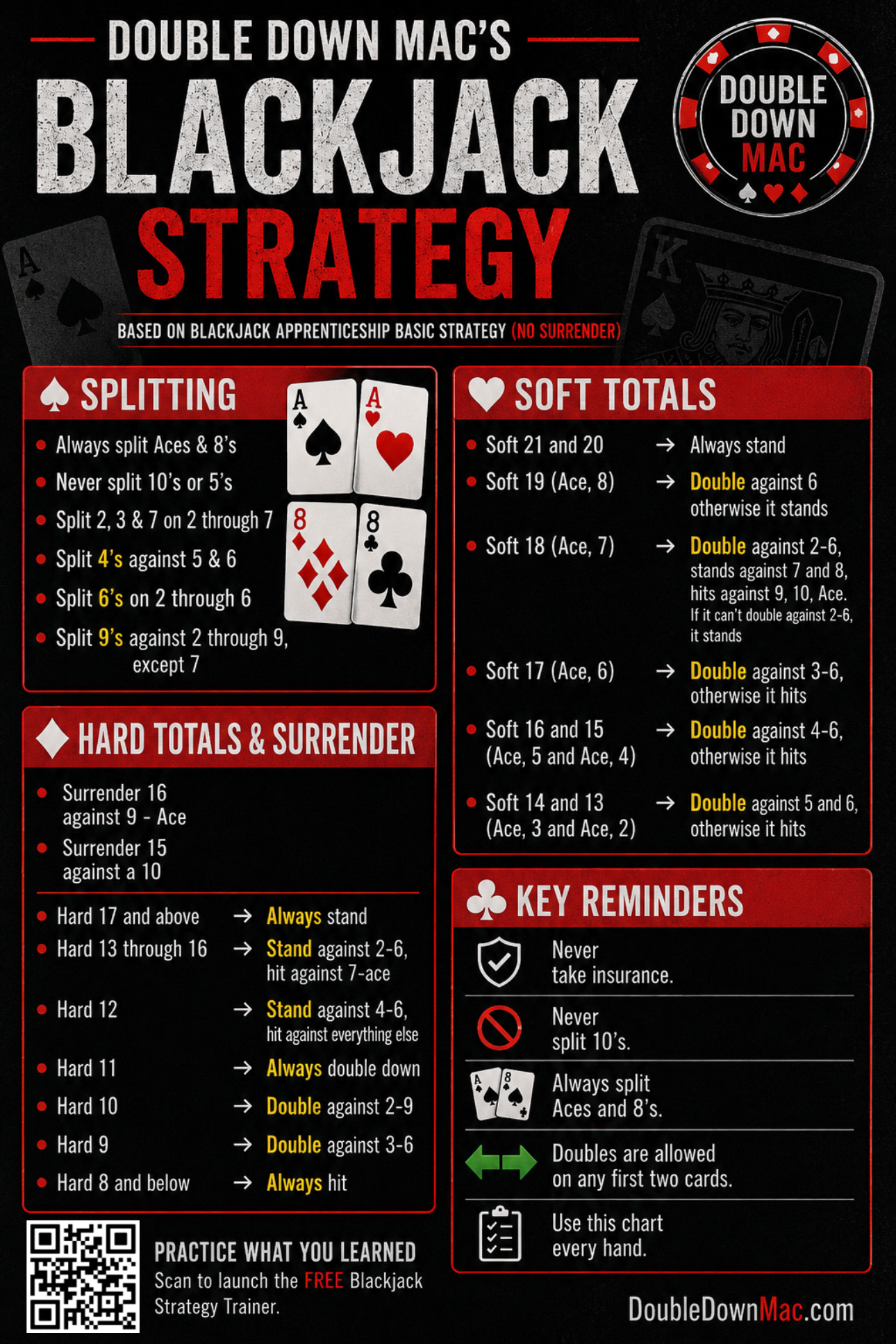
I use a basic strategy chart covering hard totals, soft totals, splitting, and surrender decisions for the blackjack rules I practice.
You can save a strategy chart to your phone, download a printable PDF, or use it as a reference while learning.
There’s absolutely nothing wrong with bringing a strategy card to the table.
I don’t personally use one because I’ve memorized the strategy, but I spent a lot of time getting to that point.
I’d rather see somebody checking a chart and making the correct decision than guessing because they’re worried about what the other players think.
Download the Free Bet Stay Win Blackjack Basic Strategy PDF
Stop guessing. Start learning the correct plays.
I’ve put together a free printable blackjack basic strategy PDF through Bet Stay Win. It’s designed for six-deck blackjack games where the dealer hits soft 17 and doubling after splitting is allowed.
The printable chart covers hard totals, soft totals, pair splitting, surrender decisions, and alternatives for tables that don’t offer surrender.
It’s black and white, so you can print it without using half your printer’s ink. Save a copy to your phone, keep it handy while studying, or bring a printed version with you to the casino.
DOWNLOAD THE FREE BLACKJACK BASIC STRATEGY PDF →
Free download • Printable PDF • Six-deck H17 blackjack • Bet Stay Win
Practice Blackjack Strategy Before Gambling
Reading a strategy chart is one thing.
Actually remembering what to do when you’re sitting at a table is another.
That’s why I recommend practicing before you start risking real money.
I use my own blackjack strategy trainer to run through hands whenever I want.
It gives you different hands and dealer upcards so you can practice making the correct decisions.
You can work through hard totals, soft totals, splitting, and doubling without losing a dollar.
Practice Blackjack Basic Strategy With My Free Blackjack Trainer →
You don’t need to memorize the entire chart overnight.
Just keep practicing.
Eventually, a lot of the decisions become second nature.
Blackjack Rules That Can Change Your Strategy
Before you start playing, understand that not every blackjack table offers the same game.
Some of the differences are small.
Others can make the game considerably worse for players.

Dealer Hits or Stands on Soft 17
Some casinos require the dealer to hit soft 17.
Others require the dealer to stand.
You’ll usually see this printed directly on the table.
The difference changes the house edge and certain basic strategy decisions.
The strategy examples used in this guide assume the dealer hits soft 17.
Double After Splitting
Some tables let you double down after splitting a pair.
Others don’t.
This affects some of your splitting decisions, which is why it’s important to understand the rules before applying a strategy chart.
Surrender or No Surrender
A lot of blackjack tables don’t offer surrender.
If it isn’t available, you simply follow the correct alternative basic strategy play.
For example, under our rules, a hard 16 against a dealer’s 10 is a surrender when late surrender is allowed.
Without surrender, you hit an ordinary hard 16 against that 10.
Pairs need to be evaluated separately before applying hard-total decisions.
3:2 Versus 6:5 Blackjack
This is one rule I always recommend checking before sitting down.
A natural blackjack is an Ace and a 10-value card as your first two cards.
At a traditional 3:2 table, a $20 blackjack wins $30.
At a 6:5 table, that same $20 blackjack wins $24.
You’re getting paid less money for the exact same hand.
I’ve written an entire article explaining why 6:5 blackjack is worse than 3:2 blackjack, including how the payouts affect your expected losses.
For now, just understand that not every blackjack table is equally good.
Learning to recognize the difference is part of learning how to play the game.
Should You Take Insurance in Blackjack?
When the dealer is showing an Ace, the casino may offer you insurance.
Insurance is a separate bet that pays 2:1 if the dealer has blackjack.
You can generally wager up to half your original bet.
I never take insurance when I’m playing regular basic strategy.
The reason is simple.
Unless you have additional information about the remaining cards, insurance is generally a losing bet over time.
Card counters sometimes take insurance when the count indicates that enough 10-value cards remain to make the wager profitable.
But if you’re a beginner learning basic strategy, my recommendation is to skip it.
And no, insurance isn’t suddenly a good idea because you’ve got a 20 and don’t want to lose.
Your First Time Sitting at a Casino Blackjack Table
Here’s something I don’t think enough blackjack guides talk about.
When I first started playing blackjack in casinos, I was nervous about sitting down.
It wasn’t because I didn’t understand the goal of the game.
And it wasn’t really about the money.
I just didn’t want to sit down at a table and look like an asshole because I didn’t know what I was doing.
I remember searching the internet for blackjack table etiquette before I went.
I wanted to know when to buy in, how to signal the dealer, whether I was supposed to touch the cards, and all the little things that seem obvious once you’ve played for a while.
So if you’re feeling that way, I get it.
Here’s what you need to know.

How to Buy In at a Blackjack Table
First, make sure the table is accepting new players.
If you’re unsure, just ask the dealer.
Once there’s a break between hands, place your cash on the table in front of you.
Don’t try to hand the money directly to the dealer.
The dealer will exchange your cash for chips.
And that’s it.
You’re officially sitting at a blackjack table.
Blackjack Hand Signals
At most face-up shoe games, you’ll use hand signals to communicate your decisions.
- Hit: Tap the table with your finger.
- Stand: Wave your hand horizontally over your cards.
- Double: Place an additional wager next to your original bet and signal your intention.
- Split: Put out a matching wager and indicate that you’re splitting.
- Surrender: Tell the dealer you want to surrender and follow their instructions.
Hand signals matter because the casino cameras need to see what decision you made.
If you’re unsure how to signal something, just ask the dealer.
Also, don’t touch the cards at a face-up shoe game. Handheld single- and double-deck games may have different procedures, so follow the dealer’s instructions.
Don’t Worry About Slowing Down the Table
When you’re new, it can feel like everybody is waiting for you to make your decision.
Sometimes they are.
But that’s not a reason to start randomly hitting and standing because you’re nervous.
Take a moment, look at the dealer’s card, and make your decision.
If you need help understanding the procedure, the dealer can usually explain it.
And if you want to keep a basic strategy card handy, do it.
Most people at a blackjack table are too busy worrying about their own money to care how you’re learning.
Do Other Players Affect Your Blackjack Results?
This might be the most annoying argument in blackjack.
You’ve probably heard somebody complain that another player took the dealer’s bust card.
Or that somebody shouldn’t have hit their 16.
Or that the player at third base ruined the entire table.
I’ve heard it all.
And I’ve definitely sat there watching somebody make a terrible basic strategy decision, thinking, this dumb motherfucker.
Usually followed by being thankful that one of the old guys who likes yelling at everybody isn’t sitting at the table.
But here’s the thing.
Other players making incorrect decisions don’t consistently make you lose more money.
Their decisions change which cards are dealt, but they don’t reliably change your long-term results for better or worse in a game with an effectively random shoe.
Sometimes a bad decision will cost the table.
Sometimes that exact same bad decision will save everybody.
You just remember the times it costs you.
I don’t correct other players.
It’s their money.
I might think their decision is ridiculous, but that doesn’t make it my business.
Learn your strategy, play your hand, and don’t worry about somebody else’s cards.
How Much Money Should a Beginner Bring to Blackjack?
My answer is pretty simple.
Whatever amount you’re comfortable losing.
If you lose that entire amount, it shouldn’t create a financial problem.
Personally, I wouldn’t recommend sitting down with less than $100 as a beginner, assuming the table minimum makes that reasonable.
Even $100 can disappear quickly at a $15 or $25 table.
If you’re playing $25 a hand, that money only covers four initial bets.
And that doesn’t account for splits or doubles.
A beginner should look for the lowest reasonable minimum at a table with decent rules.
Give yourself enough money to experience the game without feeling like every single hand is going to determine whether you can keep playing.
If you can’t afford the minimums, there’s nothing wrong with waiting or practicing for free.
You’re not missing some guaranteed money-making opportunity.
It’s blackjack.
The casino will still be there.

Understanding Winning and Losing Streaks
One thing new players need to understand is how much blackjack swings.
You can sit down and win five hands in a row.
You can also lose five hands in a row.
Neither one necessarily means anything about how well you’re playing.
That’s variance.
And the longer you play, the more you’ll experience it.
One of my personal bad habits is counting how many hands I’ve lost in a row.
When I get to five, there’s a pretty good chance I’m throwing a $100 bet out there.
I know basic strategy.
I know that losing five hands doesn’t mean I’m more likely to win the sixth.
I understand all of that.
And sometimes I still do it.
That’s not blackjack strategy. That’s me getting impatient and deciding the next hand should probably fix the last five.
Sometimes it works, which doesn’t exactly help discourage the behavior.
But increasing your bet because you’ve been losing doesn’t change the odds of the next hand.
And if you keep increasing your wagers to recover losses, those swings can get expensive very quickly.
This is something I think beginners need to understand right away.
Basic strategy tells you how to play your cards. It doesn’t tell you how to manage your emotions or your bankroll.
You need to figure that part out separately.
And if you’re on a winning streak, don’t assume it’s going to last forever either.
I’ve had some great blackjack sessions where it felt like I couldn’t lose.
I’ve also had sessions where I probably should’ve walked away a lot sooner.
In fact, I once played perfect blackjack strategy and lost $700 before dinner.
That experience is a pretty good reminder that making the correct decisions doesn’t guarantee you’re leaving the casino with more money than you brought.
Winning a few hands doesn’t mean you’ve figured out a way to beat the casino.
For a regular basic strategy player, the house still has an advantage.
The Biggest Blackjack Mistakes Beginners Make
There are plenty of ways to make mistakes in blackjack, but a few stand out to me.
Not Learning Basic Strategy
This is easily my biggest one.
People sit down and start making decisions based on how they feel about their hand instead of what the math says.
They refuse to hit a soft 18.
They stand on a 12 because they’re afraid of busting.
They won’t split 8s because they don’t want to put more money on the table.
And sometimes those decisions work.
That doesn’t make them correct.
Learning basic strategy gives you a consistent approach based on expected results over many hands.
Assuming the Dealer Is Going to Bust
Just because the dealer is showing a 5 or 6 doesn’t guarantee anything.
Those are weaker dealer upcards, but the dealer can still make a strong hand.
Basic strategy accounts for that probability.
You don’t need to guess.
Playing Insurance Without Understanding It
Insurance sounds like protection, but it’s really just another wager.
And unless you’re counting cards and have a reason to believe it’s profitable, you’re generally better off leaving it alone.
Playing Side Bets Without Understanding the Cost
Perfect Pairs, 21+3, and other blackjack side bets can be entertaining.
But they generally carry a substantially larger house edge than the main blackjack game played with good basic strategy.
If you want to play them for entertainment, that’s your decision.
Just understand what you’re buying.
I wouldn’t recommend them as part of learning how to play blackjack well.
Trying to Win Back Every Loss
This one I’m apparently still working on.
When you lose a few hands, it’s tempting to increase your bet because you’re due for a win.
But the cards don’t know how much you’ve lost.
They don’t know you’re frustrated.
And they definitely don’t care that you’d like to get back to even before dinner.
Increasing your bet size doesn’t make your next hand more likely to win.
I’ve written about some of these habits in 7 Biggest Lies Gamblers Tell Themselves, because apparently knowing something is a bad idea doesn’t always stop us from doing it.
Is Blackjack Skill or Luck?
Both.
In the short term, luck plays a huge role in your results.
You can play perfect basic strategy and lose every dollar you brought to the table.
You can also make terrible decisions and have an amazing session.
I’ve watched both happen.
But over the long run, the mathematical quality of your decisions matters.
That’s what makes blackjack different from games where there’s very little opportunity to affect the house edge through your choices.
By learning basic strategy, you’re reducing the cost of playing the game.
But don’t confuse that with having an advantage over the casino.
Basic strategy alone generally won’t make blackjack a profitable game.
Card counting is different because it uses information about the cards remaining in the shoe to identify situations where the player may have an advantage.
That’s a much bigger subject, and one you don’t need to understand to enjoy blackjack as a beginner.
Start with the fundamentals.
There’s plenty to learn before you start worrying about counting cards.
How to Get Better at Blackjack Without Losing Money
If I were learning blackjack from scratch today, I’d do things in a pretty specific order.
First, learn the rules and understand what all the cards are worth.
Then learn the differences between hard and soft totals.
After that, start studying basic strategy.
Don’t just memorize that you’re supposed to hit a 12 against a 2.
Understand that your decision depends on the dealer’s upcard and the mathematical possibilities of the hand.
Practice with a trainer until you’re getting the majority of your decisions correct.
Then keep practicing.
You can use the downloadable strategy chart when you need help.
And when you finally feel comfortable sitting at a casino table, start with a small bankroll and a table minimum that works for you.
There’s no prize for learning blackjack the expensive way.
Start Practicing With the Free Blackjack Strategy Trainer →
Frequently Asked Questions About Blackjack
Is blackjack easy to learn for beginners?
Yes. The basic rules of blackjack are relatively simple. Your goal is to beat the dealer without going over 21. Learning the rules might only take a few minutes, but learning basic strategy takes practice.
What is the goal of blackjack?
The goal is to have a better hand than the dealer without exceeding 21. You can also win when the dealer busts, provided you haven’t already busted yourself.
What is the best blackjack strategy for beginners?
Basic strategy is the best place to start. It uses mathematical probabilities to determine when you should hit, stand, double down, split, or surrender based on your hand and the dealer’s upcard.
Should you always hit on 16 in blackjack?
No. The correct decision depends on the dealer’s upcard and whether your hand is a pair. For example, with a regular hard 16, basic strategy generally calls for standing against dealer 2 through 6 and hitting against 7 through Ace when surrender isn’t available. A pair of 8s is handled differently.
Should you split 8s against a dealer’s 10?
Yes. Under the standard six-deck American blackjack rules used in this guide, basic strategy calls for splitting a pair of 8s against a dealer’s 10.
Should beginners take insurance in blackjack?
Generally, no. Insurance is a separate wager that usually has a negative expected return for players who aren’t counting cards.
Can you use a basic strategy card at a casino?
Many casinos allow players to reference a printed basic strategy card at the table. However, individual casino policies can vary, particularly when it comes to electronic devices. Ask the dealer if you’re unsure.
How much money should a beginner bring to blackjack?
Only bring an amount you’re comfortable losing. I personally suggest having at least $100 available if the table minimum is appropriate, but even that can disappear quickly. Choose a table with betting limits that fit your budget, including enough room for doubles and splits.
Does basic strategy guarantee you’ll win at blackjack?
No. Basic strategy reduces the casino’s mathematical advantage, but it doesn’t eliminate short-term losses or guarantee a profitable session.
What’s the difference between 3:2 and 6:5 blackjack?
The difference is how much the casino pays for a natural blackjack. A 3:2 table pays $30 on a $20 blackjack, while a 6:5 table pays only $24. That difference increases the casino’s advantage.
What’s the difference between blackjack basic strategy and card counting?
Basic strategy uses your hand and the dealer’s upcard to determine the best play under the table’s rules. Card counting tracks information about cards already dealt to estimate the composition of the remaining shoe. Basic strategy is the foundation you should learn first.
What if the blackjack table doesn’t offer surrender?
You use the appropriate basic strategy alternative instead. For example, without surrender, a regular hard 16 against a dealer’s 10 is a hit under the rules used in this guide. Always apply pair-splitting rules separately.
Final Thoughts: Learn the Game Before You Spend Your Money
I’ve been playing blackjack in one form or another since I was a kid.
Back then, I was happy playing dollar hands with my friends and trying to remember how many Aces had already come out of the deck.
Years later, I discovered how much strategy was actually involved and spent a ridiculous amount of time learning it.
I’m glad I did.
Knowing basic strategy makes blackjack more interesting to me.
I’m not guessing what to do every hand. I’m making decisions based on something I’ve studied and practiced.
That doesn’t mean I always win.
And it definitely doesn’t mean I always make good decisions about how much money to bet.
But at least when I lose a hand, I usually know whether I played the cards correctly.
For anybody thinking about playing blackjack for the first time, my advice is simple.
Learn basic strategy before you spend your money.
You don’t need to become a professional card counter or memorize every possible rule variation.
Just learn how the game works, practice the correct decisions, and get comfortable with the idea that sometimes you’re going to lose even when you do everything right.
That’s blackjack.
Did you learn basic strategy before sitting down at a casino table, or did you figure it out after you’d already donated a few hundred dollars to the cause?