

Theo vs ADT vs Average Bet
The casino knows exactly how valuable you are as a gambler. The question is, do you?
Ever wonder why one person gets free hotel rooms, casino free play, and dinner offers while somebody else barely gets a discount on a buffet?
It’s not necessarily because one player lost more money than the other.
It’s because casinos have a system for figuring out what you’re worth to them. And three of the biggest pieces of that system are Average Bet, Theo, and ADT.
I’ve been gambling in Las Vegas and Detroit casinos for years. I’ve gotten comped rooms, free play, promotional gifts, and plenty of offers inviting me to come back and gamble some more.
I’ve also made mistakes over the years because I didn’t understand how some of this stuff worked.
These days, I pay a lot more attention to how casinos rate my play. I’m not making extra trips or blowing through money just to chase rewards, but if I’m going to be gambling anyway, I might as well understand how to get the most out of it.
So let’s break down these three numbers, look at some actual casino math, and talk about a few habits I’ve picked up along the way.
Don’t worry. The math isn’t complicated. If you can calculate how much you’ve lost at a blackjack table, you’ll be fine.
And if you can’t, sometimes that’s probably for the best.
What Is Average Bet?
Average Bet is exactly what it sounds like. It’s the average amount of money you’re wagering while gambling.
If you’re sitting at a blackjack table betting $25 every hand, your average bet is $25.
If you’re spinning a slot machine at $2.50 per spin, that’s your average wager.
Pretty simple.
But this is where things start to get interesting, because casinos don’t track every game the same way.
On slot machines, your wagers can be recorded electronically when you’re using your players card. The casino knows how much money you’re cycling through the machine, which games you’re playing, and how much wagering activity you’re generating.
At traditional table games, things can work differently.
The pit boss or floor supervisor generally estimates your average bet, records how long you’re playing, and uses that information to help determine your rating.
And unlike a slot machine, where the system can record every wager, table game ratings may involve somebody actually watching you play.
Which brings me to something I’ve been doing for years.
How Casinos Rate Your Blackjack Bets

Years ago, I learned something from the old Comp City approach to casino gambling.
When I notice the pit boss watching me, I sometimes increase my bets.
Let’s say I’ve been playing $25 hands for a while. If I notice the supervisor paying attention, I might start throwing out $50 bets instead.
My thinking has always been pretty simple. If the pit boss happens to observe those larger wagers, maybe my recorded average bet will reflect some of that.
I’ve been doing it for years, and I feel like it’s helped me get better ratings and offers.
Now, before somebody reads this and starts doubling every bet whenever a guy in a suit walks past the table, there are a few things you should understand.
The pit boss might have been watching you long before you noticed. Some casinos use more sophisticated tracking systems, and one or two bigger wagers aren’t necessarily going to change your rating.
Also, betting more money means risking more money. There’s no guarantee that a slightly higher recorded average bet will produce enough additional comps to justify the extra exposure.
This is something I personally do, not some guaranteed secret trick for beating casino rewards programs.
But understanding how your average bet gets recorded is important, because that number feeds directly into the next measurement.
Theo.
What Is Theo (Theoretical Loss)?
Theo is short for theoretical loss.
It’s the amount of money a casino mathematically expects to win from your gambling activity over time.
Notice I said expects to win.
Not how much you actually lost.
Those are two very different things.
You could sit at a blackjack table, lose $500, and still generate only $60 in theoretical loss.
Or you could walk away winning $1,000 and generate that same $60 in Theo.
That’s because the calculation isn’t based solely on whether you won or lost during that particular session.
It’s based on your wagering activity and the mathematical advantage the casino has over the game.
How Casinos Calculate Theo
For traditional table games, a simplified formula looks like this:
Theo = Average Bet × Decisions Per Hour × Hours Played × House Edge
Here’s what each part means:
- Average Bet: How much you’re wagering per hand.
- Decisions Per Hour: Approximately how many hands you play in an hour.
- Hours Played: Your total playing time.
- House Edge: The mathematical advantage the casino has over the player.
For slot machines, the calculation can be simpler:
Slot Theo = Total Coin-In × Theoretical Hold Percentage
That gives the casino an estimate of how much money your gambling activity is expected to generate for the house over the long run.
This isn’t just something gamblers made up. Casino industry analysts use theoretical loss when estimating player value and predicting future gambling activity.
For a more technical explanation, this SAS paper on casino patron analytics explains how casinos use actual and theoretical gaming results to evaluate customers.
But I think the easiest way to understand Theo is to look at a couple of examples.
Blackjack vs. Slot Machine Theo: Real Math Examples
Example 1: Four Hours of Blackjack
Let’s say you spend four hours playing blackjack with an average bet of $25.
For this example, we’ll assume you’re playing 60 hands per hour and use a 1% house edge.
| Metric | Value |
|---|---|
| Average Bet | $25 |
| Hands Per Hour | 60 |
| Hours Played | 4 |
| Assumed House Edge | 1% |
| Total Wagered | $6,000 |
| Theoretical Loss | $60 |
That’s right.
You sat at a blackjack table for four hours, wagered approximately $6,000 over the course of the session, and the casino theoretically expected to win $60.
Meanwhile, you might have actually lost $400.
Apparently, you exceeded expectations.
Of course, the real house edge depends on blackjack rules and how accurately you play. The casino may also use its own assumptions for hands per hour and rating calculations.
Example 2: Three Hours Playing Slots
Now let’s look at somebody playing slot machines.
We’ll use a $2 wager, 400 spins per hour, and an assumed 8% casino hold.
| Metric | Value |
|---|---|
| Average Spin | $2 |
| Spins Per Hour | 400 |
| Hours Played | 3 |
| Assumed Casino Hold | 8% |
| Total Coin-In | $2,400 |
| Theoretical Loss | $192 |
Look at that difference.
Our blackjack player generated $60 in Theo over four hours, while the slot player generated $192 in just three hours.
That’s more than three times the theoretical loss.
And that’s one reason slot play can generate substantial value in casino rating systems.
But don’t confuse generating more Theo with making a smarter gambling decision.
Higher theoretical loss means the casino expects to make more money from you over time.
That’s good for their business. Not necessarily yours.
The point is to understand what your gambling is worth to the casino, not to lose more money trying to impress it.
What Is ADT (Average Daily Theoretical)?
Now we’re getting into the number I really want people to understand.
ADT stands for Average Daily Theoretical.
Instead of looking at your total expected gambling loss, ADT looks at your average theoretical value over the casino days included in its calculation.
Many casinos use ADT when deciding what kinds of promotional offers to send players.
Free rooms, free play, discounted stays, and other incentives can all be influenced by your daily gambling value.
The simplified formula is:
ADT = Total Theoretical Loss ÷ Number of Counted Casino Days
Sounds simple enough.
But there’s a catch.
Depending on the casino, a very short gambling session can sometimes count as another rated day.
And that can change your average.
Casinos don’t all calculate ADT the same way. Some use different measurement periods, qualifying thresholds, or trip-based calculations, so this formula is meant to explain the concept rather than reproduce any particular casino’s internal system.
How a Ten-Minute Gambling Session Can Affect Your ADT
Let’s say you visit a casino three times during the week.
Each visit generates $150 in theoretical loss.
| Casino Day | Theo |
|---|---|
| Monday | $150 |
| Wednesday | $150 |
| Friday | $150 |
| Total Theo | $450 |
Your ADT is $450 divided by three days.
ADT = $150
Not bad.
Now imagine the casino invites you back on Saturday to pick up a promotional gift.
You’re already there, so you decide to put $20 into a slot machine.
You insert your players card, play for ten minutes, and leave.
Let’s say that session generates $5 in theoretical loss and the casino counts Saturday as an additional rated day.
| Casino Day | Theo |
|---|---|
| Monday | $150 |
| Wednesday | $150 |
| Friday | $150 |
| Saturday | $5 |
| Total Theo | $455 |
Now divide $455 by four days.
New ADT = $113.75
Your total theoretical loss actually increased, but your average daily theoretical dropped by more than 24%.
Think about that.
One ten-minute session potentially changed your daily player rating significantly.
Does that guarantee your future casino offers will get worse? Absolutely not. Different casinos use different rating and marketing systems.
But this is exactly why understanding ADT matters.
Why I Sometimes Don’t Play Rated at MotorCity Casino

Here’s a real example of how I use what I’ve learned about ADT.
MotorCity Casino in Detroit sends me promotional emails all the time.
Sometimes it’s free play. Sometimes it’s a gift. Sometimes it’s something for the kitchen that I probably wouldn’t have gone shopping for myself.
Like this MasterChef baking dish they were giving away in November 2026.
Now, if I’ve got time to gamble and money set aside for it, that’s one thing.
But sometimes I’m just stopping in to collect the gift.
Maybe I’m in a hurry. Maybe I don’t have a lot of cash on me. Maybe I just don’t feel like sitting down and gambling for three hours.
Every once in a while, I’ll still get the urge to throw a little money into a slot machine.
But when I know I’m only going to be there for ten or fifteen minutes, I usually don’t insert my players card.
Why?
Because I don’t want a tiny rated session potentially affecting my average daily theoretical.
If I happen to hit something substantial and decide to stick around for a longer session, I might start playing rated from that point forward.
That doesn’t retroactively add the earlier play to my rating, but it means future play can be tracked.
Now, I don’t know MotorCity’s exact internal ADT calculation. I’m not claiming that every ten-minute visit automatically damages your offers.
I’m also aware that not using my card means giving up points and potentially other rewards for that session.
It’s a tradeoff.
But it’s a decision I make because I understand what ADT is and how it can work.
And sometimes knowing when not to use your card is just as useful as knowing when to use it.
Theo vs. ADT vs. Average Bet: What’s the Difference?
Let’s put everything together in one simple comparison.
| Metric | What It Measures | Why It Matters |
|---|---|---|
| Average Bet | Your typical wager | Helps calculate theoretical loss |
| Theo | Expected casino win from your play | Helps estimate your gambling value |
| ADT | Average Theo per counted casino day | Can influence future marketing offers |
Your average wager helps determine your theoretical loss.
Your theoretical loss contributes to your ADT.
And those numbers help casinos estimate what kind of customer you are.
That doesn’t mean casinos ignore actual losses, historical play, or how frequently you visit.
It just means there’s a lot more happening behind the scenes than most players realize.
And once you understand those numbers, some of those casino offers start making a lot more sense.
Why MGM Keeps Offering Me Free Rooms
I’ll admit something.
Every once in a while, I look at my MGM Rewards offers and wonder why they keep inviting me back.
I’ve stayed at MGM Grand, Luxor, Excalibur, and other MGM properties using casino offers.
And I’ve already got another comped trip to Mandalay Bay coming up.
Sometimes I look at those offers and think I’ve got a pretty good deal going.
Then I open the MGM Rewards app and look at our gambling activity.
And suddenly, it makes a lot more sense.
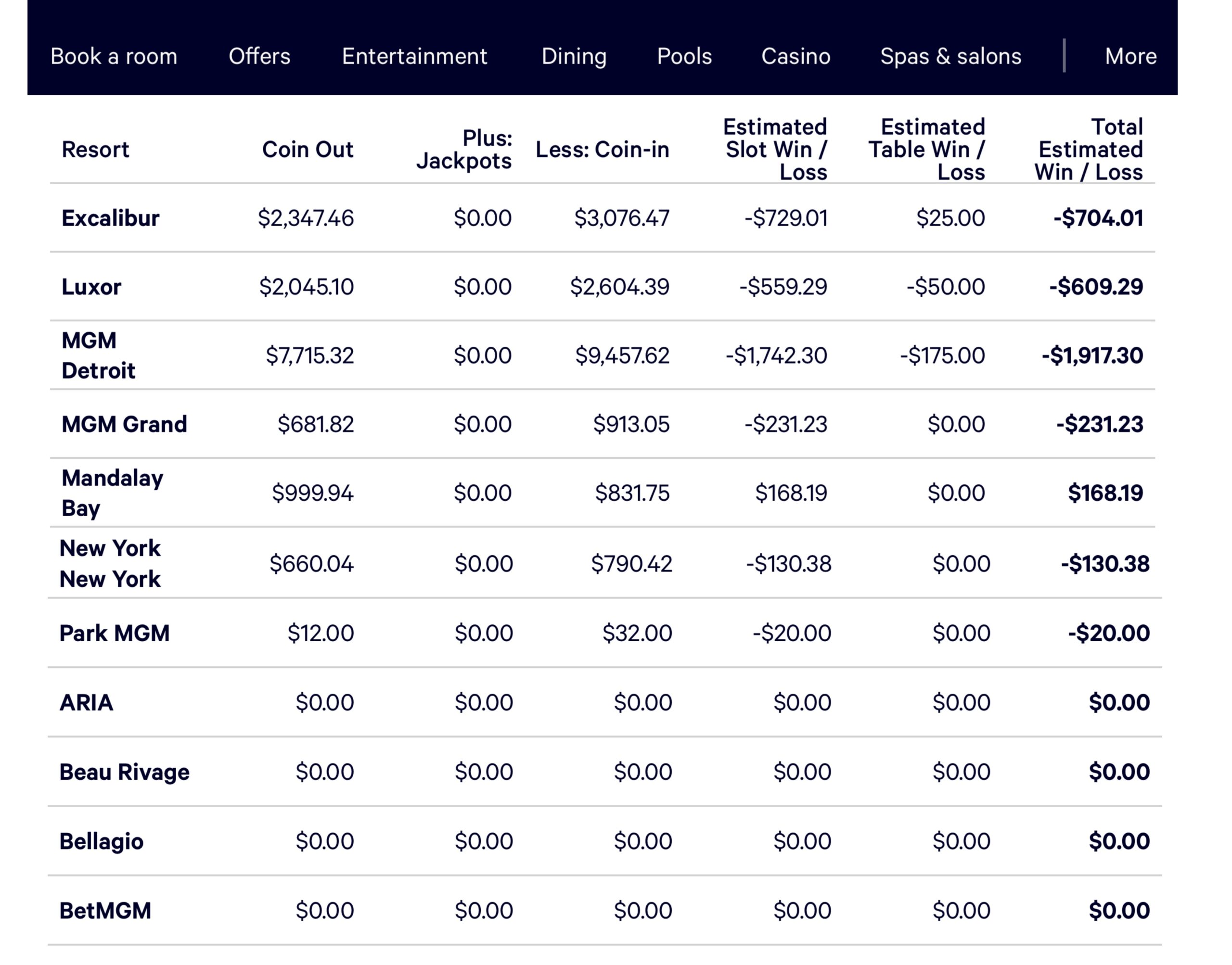
Look at those numbers.
Across the properties shown in this report, there’s more than $17,700 in slot coin-in.
MGM Grand alone shows over $9,400 in coin-in, and MGM Detroit accounts for another $3,000-plus.
Now, before anybody thinks I’ve been carrying around seventeen grand in cash, that’s not what coin-in means.
Coin-in is the total amount wagered through the slot machines.
If you put $100 into a machine, win some money, and keep playing those winnings, the same original money can generate hundreds or even thousands of dollars in additional coin-in.
That’s why coin-in can be significantly higher than the amount of money you actually brought to the casino.
It’s also important to understand that this report shows actual wagering activity and estimated wins and losses. It doesn’t reveal MGM’s internal theoretical-loss or ADT calculations.
Still, when I look at the amount of gambling activity on the account, I can understand why MGM keeps offering rooms.
Nikki and I both spend time gambling when we’re in Vegas, and our MGM Rewards relationship includes linked accounts and eligible shared benefits.
Between our slot play and my blackjack sessions, the casinos have plenty of gambling activity to evaluate.
And we’ve made good use of the offers.
I’ve written before about why I don’t do luxury Vegas the way some influencers do. I’d much rather stay in a comped room and have more money available for the rest of the trip.
That’s part of why I like casino offers so much.
I’m not going to pretend those rooms are being handed out because MGM likes my personality.
They have a business reason for inviting me back.
And I’m perfectly fine taking advantage of the offer when it makes sense for me.
They give me a room. I come to Vegas and gamble.
Everybody seems pretty happy with the arrangement.
Casino Tier Status and Comps Are Not the Same Thing
Here’s another thing that confuses a lot of players.
Your casino loyalty tier is not the same thing as your ADT.
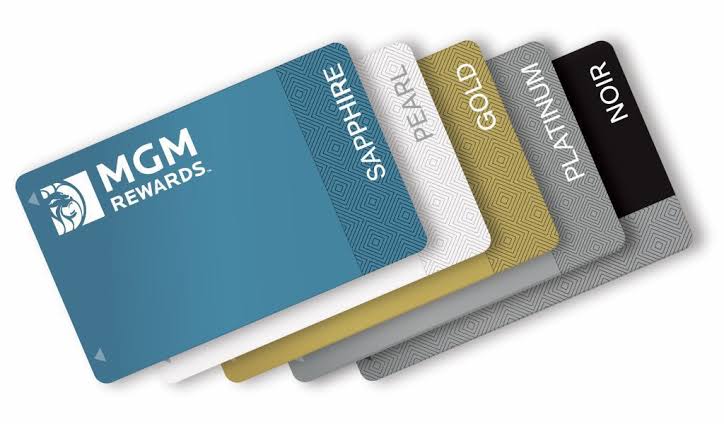
At MGM, for example, you earn Tier Credits toward different membership levels.
Those levels can unlock benefits like parking privileges, waived resort fees, and other perks depending on your status.
But your personalized room offers and free play can also depend on gambling activity and other marketing considerations.
That means somebody with a lower loyalty tier might still receive attractive casino offers based on their rated gambling history.
And somebody with a higher tier doesn’t automatically get the best possible room offers.
You can check the current benefits and requirements on the official MGM Rewards tier benefits page.
I’ve also broken down my own approach in MGM Gold Status: How Much Do You Really Need to Gamble?, including why I don’t believe in throwing unnecessary money at a casino just to reach another status level.
Tier Credits, Theo, and ADT are connected to casino rewards, but they measure different things.
Understanding that distinction can save you from chasing benefits that might not be worth the cost.
My Philosophy on Chasing Casino Comps

Here’s where I think some people get a little carried away with casino rewards.
They start treating comps like they’re something they have to win.
They’ll make an extra trip to the casino because they’re close to reaching another tier.
Or they’ll gamble another couple hundred dollars because they think it’ll get them a better hotel offer.
And look, I understand wanting to get everything you can out of a casino.
I’m all for it.
But I’m not going to start making unnecessary trips or blowing through extra money just to get another few thousand Tier Credits.
My philosophy is simple.
I’m going to gamble anyway. I might as well understand how to get the most out of it.
That’s why I pay attention to my table game ratings.
It’s why I sometimes choose not to play rated when I’m only stopping by a casino for a few minutes.
It’s also why I take advantage of promotions and multipliers when they fit into trips I already planned.
What I’m not going to do is lose another $300 chasing a benefit worth $75.
At that point, I could have just bought the damn thing.
And sometimes the best comps aren’t even the fancy ones.
I’ve written about the time casino comps somehow turned into a free tampon haul. Not exactly the kind of high-roller experience you see advertised on the Strip, but free is free.
For me, the goal is to get the most value out of my gambling without turning rewards into another reason to spend money.
The same thinking applies when I’m booking a hotel. I’ll explore every reasonable opportunity to improve my stay, including the difference between mobile check-in and trying for a Las Vegas hotel upgrade at the front desk.
I’ll take whatever legitimate perks are available.
I just don’t want to pay more chasing them than they’re worth.
Five Casino Rating Mistakes That Can Cost You Comps
1. Playing Short Rated Sessions Without Understanding ADT
A quick slot session may add very little theoretical value while potentially creating another counted casino day.
That won’t affect every casino rating system the same way, but it’s worth understanding how your particular rewards program works.
2. Thinking Actual Losses Equal Theo
Just because you lost $800 doesn’t mean the casino assigned you $800 in theoretical loss.
Your expected loss can be much smaller than your actual loss during an unlucky session.
And the opposite is true when you win.
3. Not Making Sure Your Table Play Is Rated
If you’re sitting at a blackjack table for several hours and want credit for your play, make sure the floor supervisor has your rewards information.
You can also ask about your recorded average bet and session time.
There’s nothing wrong with making sure your play is being tracked accurately.
4. Assuming a Higher Loyalty Tier Guarantees Better Offers
Tier status can unlock valuable benefits, but personalized room offers aren’t necessarily determined by tier status alone.
Your gambling activity, historical value, and other factors may play a major role.
5. Gambling More Than You Planned Just to Get Better Comps
This is probably the biggest mistake of all.
It’s easy to justify extra gambling when you convince yourself you’re working toward something valuable.
But higher theoretical loss means you’re giving the casino more expected gambling revenue.
Don’t spend an extra $200 chasing a $100 hotel room.
Stick to the gambling budget you were comfortable with before the comps entered the conversation.
Final Thoughts: Learn How Casinos Rate You
I’ve been gambling for years, and one of the things I’ve learned is that understanding casino rewards can be almost as useful as understanding the games themselves.
Average Bet, Theo, and ADT aren’t particularly complicated once somebody explains them.
But they can make a difference in how you look at casino offers.
Average Bet tells the casino how much you typically wager.
Theo estimates what the casino expects to win from your gambling activity.
ADT helps measure your average theoretical value over the casino days being evaluated.
They’re not the only things casinos look at, but they’re important pieces of the picture.
And now that you understand them, you can start making more informed decisions about how you use your rewards card, how your table play gets rated, and whether chasing that next comp is actually worth it.
I’m not going to pretend I’ve figured out how to beat the casino rewards system.
But I’ve learned enough over the years to avoid a few mistakes I used to make.
I’m still going to Vegas. I’m still going to gamble. And if MGM wants to keep giving me free rooms, I’m certainly not going to complain.
I just understand a little better why they’re offering them.
Have you ever noticed your casino offers getting better or worse after changing how you gamble? Come talk about it in the Double Down Mac community. I’m always interested in hearing how different casinos treat their players.
Theo, ADT & Average Bet: Frequently Asked Questions
What Does Theo Mean at a Casino?
Theo stands for theoretical loss. It’s the amount of money the casino mathematically expects to win from a player’s gambling activity over time. It’s calculated using factors like average bet, game type, playing time, and house advantage.
What Is ADT in Casino Gambling?
ADT stands for Average Daily Theoretical. It represents a player’s average theoretical loss across the casino days included in the calculation. Many casino marketing programs use ADT to help determine promotional offers.
Can Playing Slots for Ten Minutes Hurt Your ADT?
Potentially. If the session creates an additional counted casino day with very little theoretical loss, it could lower your ADT. However, casinos have different methods for calculating player value, so the effect isn’t universal.
Do Casinos Base Comps on Actual Losses or Theo?
Many casino comp systems rely heavily on theoretical loss because it estimates long-term player value. However, actual losses, previous gambling history, and other factors can also influence certain offers.
Does Betting More Increase My Casino Theo?
Generally, larger wagers increase theoretical loss when other factors remain equal. However, betting more also increases financial exposure and doesn’t guarantee additional comps or better overall value.
Does Betting More When the Pit Boss Is Watching Improve Your Rating?
Not necessarily. Traditional table game ratings may involve floor supervisor observations, but casinos can evaluate bets throughout the session. A few larger wagers don’t guarantee a higher recorded average bet.
What’s the Difference Between Casino Tier Credits and ADT?
Tier Credits are used to determine status levels in a casino loyalty program. ADT measures average theoretical gambling value over counted casino days. Personalized offers can depend on ADT and other player information rather than tier status alone.
Can You Get Free Casino Rooms Even If You Win Money?
Yes. Because casino offers can be based on theoretical gambling value, players may still qualify for complimentary rooms and other benefits even when they’ve won money during a particular session.
Should I Gamble More to Improve My Casino Comps?
Gambling more can increase your theoretical value, but it also increases your expected gambling losses. It’s generally better to treat comps as a benefit of gambling you already planned to do rather than a reason to increase your gambling budget.